$$ \newcommand{\N}{\mathbb{N}} \newcommand{\C}{\mathbb{C}} \newcommand{\R}{\mathbb{R}} \newcommand{\Z}{\mathbb{Z}} \newcommand{\ZZ}{\ooalign{Z\cr\hidewidth\kern0.1em\raisebox{-0.5ex}{Z}\hidewidth\cr}} \newcommand{\colim}{\text{colim}} \newcommand{\weaktopo}{\tau_\text{weak}} \newcommand{\strongtopo}{\tau_\text{strong}} \newcommand{\normtopo}{\tau_\text{norm}} \newcommand{\green}[1]{\textcolor{ForestGreen}{#1}} \newcommand{\red}[1]{\textcolor{red}{#1}} \newcommand{\blue}[1]{\textcolor{blue}{#1}} \newcommand{\orange}[1]{\textcolor{orange}{#1}} \newcommand{\tr}{\text{tr}} \newcommand{\id}{\text{id}} \newcommand{\im}{\text{im}\>} \newcommand{\res}{\text{res}} \newcommand{\TopTwo}{\underline{\text{Top}^{(2)}}} \newcommand{\CW}[1]{\underline{#1\text{-CW}}} % specific for this document \newcommand{\cellOne}{\textcolor{green}{1}} \newcommand{\cellTwo}{\textcolor{red}{2}} \newcommand{\cellThree}{\textcolor{brown}{3}} \newcommand{\cellFour}{\textcolor{YellowOrange}{4}} $$

Knots to Narnia

A homage to William Thurston using modern computer visualization

math
topology
knot theory
visualization
English
Author

Luca Leon Happel

Published

March 18, 2026

Warning

I have never finished this post, however at least it shows a few nice CGI visualizations of portals. So I will keep this as a historical record of my work on this topic. I will come back to it at some point and finish it.

The Fields Medalist William Thurston is famous for revolutionizing low-dimensional topology and geometry, especially through his work on 3-manifolds and the geometrization conjecture. He is beloved not just by me but by the general mathematical community for his playful, story-driven approach to algebraic topology. In “Knots to Narnia”, he imagines a magic portal shaped like a loop or knot that splits space into “parallel worlds”. An ordinary loop produces just two worlds, while a trefoil knot gives several distinct worlds connected by precise rules. By tracking simple moves through the knot, Thurston shows how these rules encode a branched covering structure in an unusually vivid, accessible way.

In this post, I will present a modern visualization of Thurston’s “Knots to Narnia” concept using computer graphics. We will explore how different knots can create various “parallel worlds” and how these worlds are interconnected.

First example: The Unknot

Let us look at the unknot embedded in \(\mathbb{R}^3\):

We render the scene using a custom ray marcher built from scratch. Unlike a traditional raytracer that solves ray-surface intersections analytically, ray marching steps along each ray incrementally, making it straightforward to later replace Euclidean straight-line steps with geodesic steps in a curved geometry.

The core loop is:

  1. For each pixel, cast a ray from the camera.
  2. Step the ray according to a step_ray function (currently Euclidean: \(\mathbf{p} \mapsto \mathbf{p} + dt \cdot \mathbf{d}\)).
  3. At each step, evaluate a signed distance function (SDF) to check proximity to the surface.
  4. On hit, compute Phong lighting; otherwise, return the background.
Code
import numpy as np
import numba as nb
from numba import njit, prange
import matplotlib.pyplot as plt

# ── Signed Distance Functions ────────────────────────────────────────

@njit
def sdf_torus(p, R, r):
    """SDF for a torus centred at the origin lying in the xz-plane.
    R = major radius, r = minor radius."""
    q = np.sqrt(p[0]**2 + p[2]**2) - R
    return np.sqrt(q**2 + p[1]**2) - r

# ── Ray stepping (swappable for non-Euclidean geometries) ────────────

@njit
def step_ray_euclidean(pos, direction, dt):
    """Advance a ray in flat R^3: straight-line geodesic."""
    new_pos = np.empty(3)
    new_dir = np.empty(3)
    for i in range(3):
        new_pos[i] = pos[i] + dt * direction[i]
        new_dir[i] = direction[i]          # direction unchanged in flat space
    return new_pos, new_dir

# ── Surface normal via central differences ───────────────────────────

@njit
def estimate_normal_torus(p, R, r):
    eps = 1e-4
    n = np.empty(3)
    for i in range(3):
        p_plus  = p.copy(); p_plus[i]  += eps
        p_minus = p.copy(); p_minus[i] -= eps
        n[i] = sdf_torus(p_plus, R, r) - sdf_torus(p_minus, R, r)
    length = np.sqrt(n[0]**2 + n[1]**2 + n[2]**2)
    if length > 0:
        for i in range(3):
            n[i] /= length
    return n

# ── Phong lighting ───────────────────────────────────────────────────

@njit
def shade(hit_pos, normal, ray_dir, light_dir):
    """Simple Phong shading (ambient + diffuse + specular)."""
    # normalise light direction
    ll = np.sqrt(light_dir[0]**2 + light_dir[1]**2 + light_dir[2]**2)
    L = np.empty(3)
    for i in range(3):
        L[i] = light_dir[i] / ll

    # diffuse
    diff = 0.0
    for i in range(3):
        diff += normal[i] * L[i]
    diff = max(diff, 0.0)

    # specular (Blinn-Phong)
    H = np.empty(3)
    for i in range(3):
        H[i] = L[i] - ray_dir[i]
    hl = np.sqrt(H[0]**2 + H[1]**2 + H[2]**2)
    if hl > 0:
        for i in range(3):
            H[i] /= hl
    spec = 0.0
    for i in range(3):
        spec += normal[i] * H[i]
    spec = max(spec, 0.0) ** 64

    ambient  = 0.10
    diffuse  = 0.70 * diff
    specular = 0.40 * spec
    return ambient + diffuse + specular

# ── Main ray-march renderer ─────────────────────────────────────────

@njit(parallel=True)
def render(width, height, fov, cam_pos, cam_target,
           torus_R, torus_r, light_dir,
           max_steps, max_dist, hit_eps):
    """Ray-march a torus scene.  Returns an (H, W, 3) float64 image."""
    image = np.zeros((height, width, 3))

    aspect = width / height
    half_w = np.tan(fov / 2.0)

    # camera basis
    forward = np.empty(3)
    for i in range(3):
        forward[i] = cam_target[i] - cam_pos[i]
    fl = np.sqrt(forward[0]**2 + forward[1]**2 + forward[2]**2)
    for i in range(3):
        forward[i] /= fl

    world_up = np.array([0.0, 1.0, 0.0])
    right = np.empty(3)
    right[0] = forward[1]*world_up[2] - forward[2]*world_up[1]
    right[1] = forward[2]*world_up[0] - forward[0]*world_up[2]
    right[2] = forward[0]*world_up[1] - forward[1]*world_up[0]
    rl = np.sqrt(right[0]**2 + right[1]**2 + right[2]**2)
    for i in range(3):
        right[i] /= rl

    up = np.empty(3)
    up[0] = right[1]*forward[2] - right[2]*forward[1]
    up[1] = right[2]*forward[0] - right[0]*forward[2]
    up[2] = right[0]*forward[1] - right[1]*forward[0]

    # object colour (torus)
    obj_col = np.array([0.35, 0.55, 0.90])
    # background colour
    bg_col  = np.array([0.94, 0.94, 0.96])

    for py in prange(height):
        for px in range(width):
            # NDC → camera ray direction
            u = (2.0 * (px + 0.5) / width  - 1.0) * half_w * aspect
            v = (2.0 * (py + 0.5) / height - 1.0) * half_w
            d = np.empty(3)
            for i in range(3):
                d[i] = forward[i] + u * right[i] - v * up[i]
            dl = np.sqrt(d[0]**2 + d[1]**2 + d[2]**2)
            for i in range(3):
                d[i] /= dl

            # march
            pos = cam_pos.copy()
            direction = d.copy()
            hit = False
            for _ in range(max_steps):
                dist = sdf_torus(pos, torus_R, torus_r)
                if dist < hit_eps:
                    hit = True
                    break
                if dist > max_dist:
                    break
                # *** THIS is the line we swap for non-Euclidean geometry ***
                pos, direction = step_ray_euclidean(pos, direction, dist)

            if hit:
                normal = estimate_normal_torus(pos, torus_R, torus_r)
                brightness = shade(pos, normal, d, light_dir)
                for c in range(3):
                    val = obj_col[c] * brightness
                    image[py, px, c] = min(max(val, 0.0), 1.0)
            else:
                for c in range(3):
                    image[py, px, c] = bg_col[c]

    return image


# ── SDF: rotated torus (hole along x-axis) ──────────────────────────

@njit
def sdf_torus_rotated(p, center_x, R, r):
    """SDF for a torus centred at (center_x, 0, 0) with hole along the x-axis."""
    px = p[0] - center_x
    q = np.sqrt(p[1]**2 + p[2]**2) - R
    return np.sqrt(q**2 + px**2) - r

# ── Portal crossing detection ────────────────────────────────────────

@njit
def check_portal_crossing(pos_old, pos_new, portal_x, portal_R):
    """Check if a ray step crossed the portal disk at x = portal_x
    with radius portal_R (in the yz-plane).
    Returns True if the ray crossed from one side to the other
    AND the crossing point is inside the disk."""
    x0 = pos_old[0] - portal_x
    x1 = pos_new[0] - portal_x
    if x0 * x1 >= 0.0:
        return False
    t = x0 / (x0 - x1)
    cy = pos_old[1] + t * (pos_new[1] - pos_old[1])
    cz = pos_old[2] + t * (pos_new[2] - pos_old[2])
    return (cy * cy + cz * cz) < portal_R * portal_R

# ── Helper: display a rendered image (no text, figure caption via Quarto) ──

def show_render(img):
    """Display a rendered image with no axes, titles, or labels.
    The figure is sized so it looks good on the page without being
    too large or too small."""
    fig, ax = plt.subplots(figsize=(7, 7), dpi=120)
    ax.imshow(img)
    ax.set_axis_off()
    plt.subplots_adjust(left=0, right=1, top=1, bottom=0)
    plt.show()


# ── Scene parameters ─────────────────────────────────────────────────

W, H     = 800, 800
fov      = np.pi / 3.0           # 60°
cam_pos  = np.array([0.0, 2.0, 4.0])
cam_tgt  = np.array([0.0, 0.0, 0.0])
light    = np.array([2.0, 4.0, 3.0])
torus_R  = 1.0                   # major radius  (unknot!)
torus_r  = 0.3                   # minor radius

img = render(W, H, fov, cam_pos, cam_tgt,
             torus_R, torus_r, light,
             max_steps=256, max_dist=50.0, hit_eps=1e-4)

show_render(img)
Figure 1: The unknot — a simple torus in ℝ³.

The key design: step_ray_euclidean is a drop-in replaceable function. To render a non-Euclidean geometry on \(\mathbb{R}^3\), we simply provide a different step_ray that integrates a geodesic ODE—for instance \(\ddot{\gamma}^k + \Gamma^k_{ij}\,\dot{\gamma}^i\,\dot{\gamma}^j = 0\) and the rest of the renderer stays unchanged.

Passing through the unknot

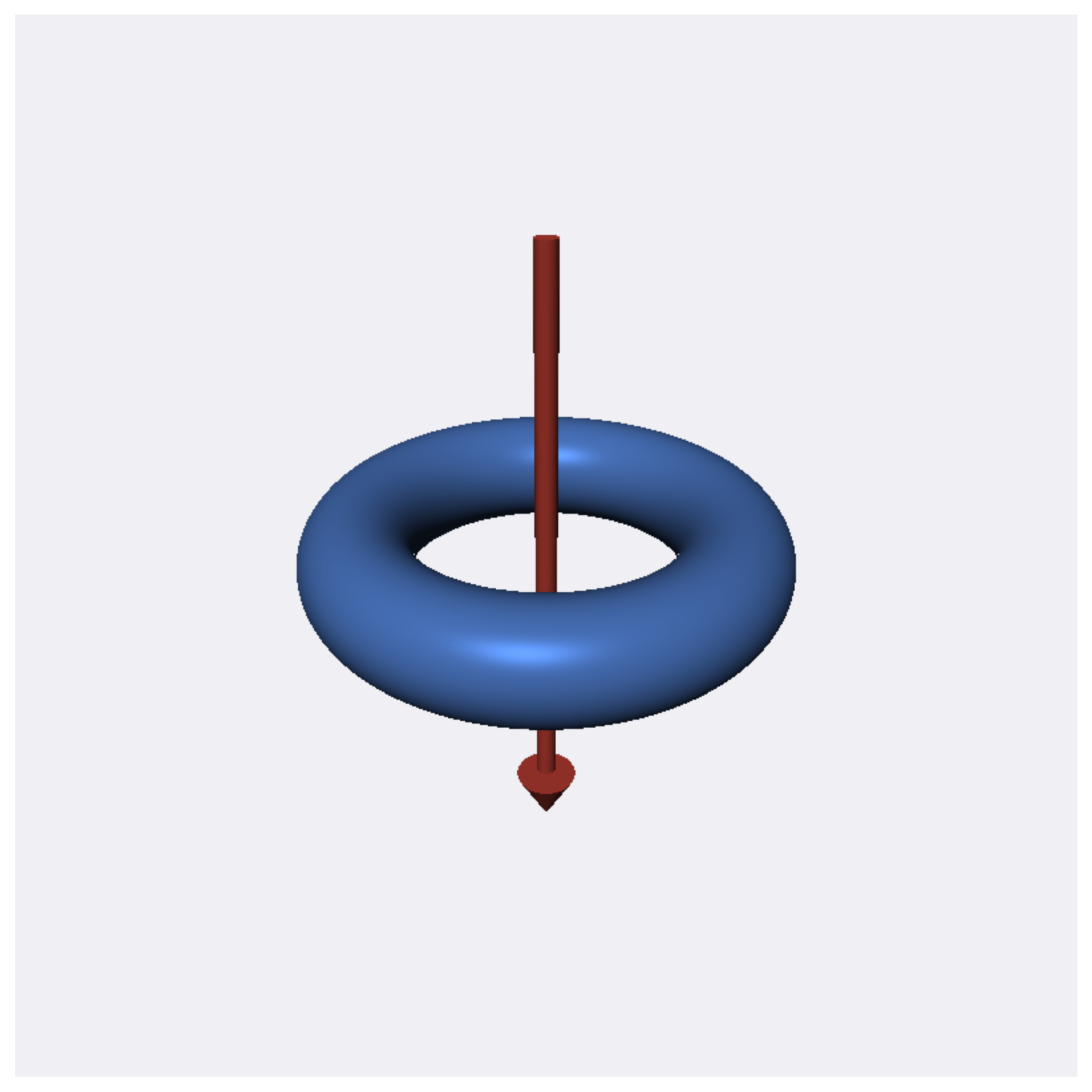
Now let us visualise the idea of passing through the unknot. We add an arrow (a cylinder with a cone tip) that pierces the torus, representing the act of crossing from one “world” to another.

Code
@njit
def sdf_cylinder(p, radius, half_height):
    """SDF for an infinite-height cylinder along the y-axis,
    capped at -half_height and +half_height."""
    d_radial = np.sqrt(p[0]**2 + p[2]**2) - radius
    d_vertical = abs(p[1]) - half_height
    # outside distance
    outside = np.sqrt(max(d_radial, 0.0)**2 + max(d_vertical, 0.0)**2)
    # inside distance
    inside = min(max(d_radial, d_vertical), 0.0)
    return outside + inside

@njit
def sdf_cone(p, radius, height, tip_y):
    """SDF for a cone with apex at (0, tip_y, 0) opening downward,
    base radius `radius` and vertical extent `height`."""
    # translate so tip is at origin
    py = tip_y - p[1]
    if py < 0.0:
        # above the tip
        return np.sqrt(p[0]**2 + p[2]**2 + (p[1] - tip_y)**2)
    pr = np.sqrt(p[0]**2 + p[2]**2)
    # cone surface: r/py = radius/height
    slope = radius / height
    # distance along the cone
    q_x = pr - slope * py
    q_y = py - height
    if q_x <= 0.0 and q_y <= 0.0:
        # inside the cone
        # distance to surface
        cos_a = height / np.sqrt(height**2 + radius**2)
        return -min(-q_x * cos_a, -q_y)
    if q_y > 0.0 and q_x <= 0.0:
        return q_y
    if q_x > 0.0 and q_y <= 0.0:
        cos_a = height / np.sqrt(height**2 + radius**2)
        return q_x * cos_a
    return np.sqrt(q_x**2 + q_y**2)

@njit
def sdf_arrow(p, shaft_radius, shaft_half_h, cone_radius, cone_height, cone_tip_y):
    """SDF for an arrow = cylinder shaft ∪ cone tip (pointing UP)."""
    d_shaft = sdf_cylinder(p, shaft_radius, shaft_half_h)
    d_cone  = sdf_cone(p, cone_radius, cone_height, cone_tip_y)
    return min(d_shaft, d_cone)

@njit
def sdf_arrow_down(p, shaft_radius, shaft_half_h, cone_radius, cone_height, cone_tip_y):
    """SDF for a downward-pointing arrow: flip y so the cone tip is at the bottom."""
    d_shaft = sdf_cylinder(p, shaft_radius, shaft_half_h)
    p_flip = np.empty(3)
    p_flip[0] = p[0]
    p_flip[1] = -p[1]
    p_flip[2] = p[2]
    d_cone = sdf_cone(p_flip, cone_radius, cone_height, cone_tip_y)
    return min(d_shaft, d_cone)

@njit
def estimate_normal_scene(p, torus_R, torus_r,
                          shaft_r, shaft_hh, cone_r, cone_h, cone_ty):
    eps = 1e-4
    n = np.empty(3)
    for i in range(3):
        pp = p.copy(); pp[i] += eps
        pm = p.copy(); pm[i] -= eps
        dp = min(sdf_torus(pp, torus_R, torus_r),
                 sdf_arrow_down(pp, shaft_r, shaft_hh, cone_r, cone_h, cone_ty))
        dm = min(sdf_torus(pm, torus_R, torus_r),
                 sdf_arrow_down(pm, shaft_r, shaft_hh, cone_r, cone_h, cone_ty))
        n[i] = dp - dm
    length = np.sqrt(n[0]**2 + n[1]**2 + n[2]**2)
    if length > 0:
        for i in range(3):
            n[i] /= length
    return n

@njit(parallel=True)
def render_arrow_scene(width, height, fov, cam_pos, cam_target,
                      torus_R, torus_r,
                      shaft_r, shaft_hh, cone_r, cone_h, cone_ty,
                      light_dir, max_steps, max_dist, hit_eps):
    image = np.zeros((height, width, 3))
    aspect = width / height
    half_w = np.tan(fov / 2.0)

    forward = np.empty(3)
    for i in range(3):
        forward[i] = cam_target[i] - cam_pos[i]
    fl = np.sqrt(forward[0]**2 + forward[1]**2 + forward[2]**2)
    for i in range(3):
        forward[i] /= fl

    world_up = np.array([0.0, 1.0, 0.0])
    right = np.empty(3)
    right[0] = forward[1]*world_up[2] - forward[2]*world_up[1]
    right[1] = forward[2]*world_up[0] - forward[0]*world_up[2]
    right[2] = forward[0]*world_up[1] - forward[1]*world_up[0]
    rl = np.sqrt(right[0]**2 + right[1]**2 + right[2]**2)
    for i in range(3):
        right[i] /= rl

    up = np.empty(3)
    up[0] = right[1]*forward[2] - right[2]*forward[1]
    up[1] = right[2]*forward[0] - right[0]*forward[2]
    up[2] = right[0]*forward[1] - right[1]*forward[0]

    torus_col = np.array([0.35, 0.55, 0.90])
    arrow_col = np.array([0.90, 0.30, 0.25])
    bg_col    = np.array([0.94, 0.94, 0.96])

    for py in prange(height):
        for px in range(width):
            u = (2.0 * (px + 0.5) / width  - 1.0) * half_w * aspect
            v = (2.0 * (py + 0.5) / height - 1.0) * half_w
            d = np.empty(3)
            for i in range(3):
                d[i] = forward[i] + u * right[i] - v * up[i]
            dl = np.sqrt(d[0]**2 + d[1]**2 + d[2]**2)
            for i in range(3):
                d[i] /= dl

            pos = cam_pos.copy()
            direction = d.copy()
            hit = False
            for _ in range(max_steps):
                d_torus = sdf_torus(pos, torus_R, torus_r)
                d_arrow = sdf_arrow_down(pos, shaft_r, shaft_hh, cone_r, cone_h, cone_ty)
                dist = min(d_torus, d_arrow)
                if dist < hit_eps:
                    hit = True
                    break
                if dist > max_dist:
                    break
                pos, direction = step_ray_euclidean(pos, direction, dist)

            if hit:
                normal = estimate_normal_scene(pos, torus_R, torus_r,
                                               shaft_r, shaft_hh, cone_r, cone_h, cone_ty)
                brightness = shade(pos, normal, d, light_dir)
                d_torus = sdf_torus(pos, torus_R, torus_r)
                d_arrow = sdf_arrow_down(pos, shaft_r, shaft_hh, cone_r, cone_h, cone_ty)
                col = torus_col if d_torus < d_arrow else arrow_col
                for c in range(3):
                    val = col[c] * brightness
                    image[py, px, c] = min(max(val, 0.0), 1.0)
            else:
                for c in range(3):
                    image[py, px, c] = bg_col[c]

    return image


# ── Render torus + arrow ─────────────────────────────────────────────

img2 = render_arrow_scene(
    800, 800, np.pi / 3.0,
    np.array([3.0, 2.5, 3.0]),       # camera slightly to the side
    np.array([0.0, 0.0, 0.0]),       # look at origin
    1.0, 0.3,                        # torus R, r
    0.06, 1.6,                       # arrow shaft radius, half-height
    0.18, 0.35, 2.0,                 # cone radius, height, tip_y
    np.array([2.0, 4.0, 3.0]),       # light
    256, 50.0, 1e-4
)

show_render(img2)
Figure 2: A torus (the unknot) with an arrow passing through it — the gateway between two worlds.

Two worlds connected by a portal

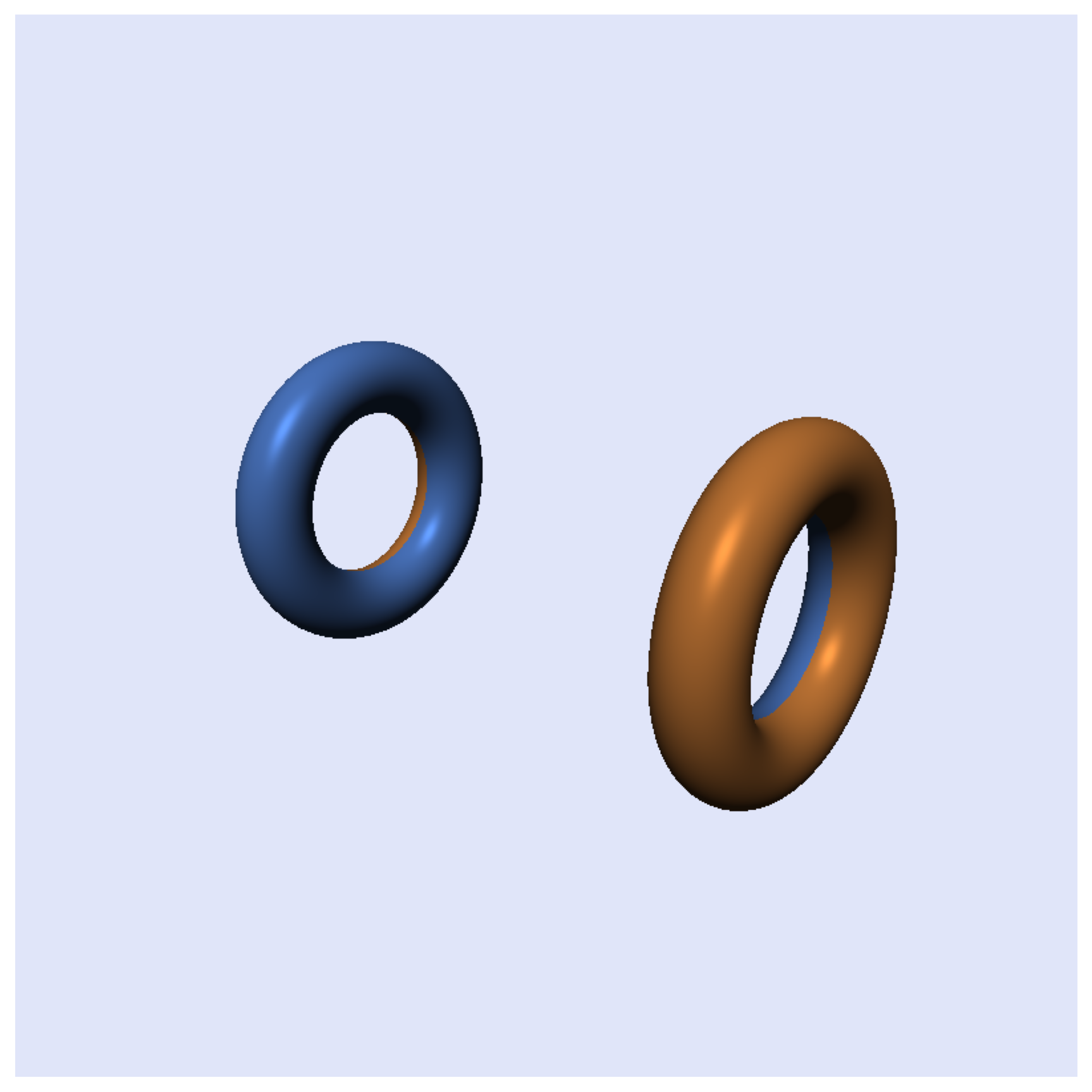
In Thurston’s picture, passing through the unknot takes you to a different copy of space: a parallel world. We visualise this by making the torus hole act as an actual portal: any light ray that passes through the disk bounded by one torus is teleported to the other torus. This means looking through one torus you see the world on the other side, as if peering through a window into Narnia.

Code
@njit
def estimate_normal_two_tori(p, torus_R, torus_r, torus_cx_L, torus_cx_R):
    eps = 1e-4
    n = np.empty(3)
    for i in range(3):
        pp = p.copy(); pp[i] += eps
        pm = p.copy(); pm[i] -= eps
        dp = min(sdf_torus_rotated(pp, torus_cx_L, torus_R, torus_r),
                 sdf_torus_rotated(pp, torus_cx_R, torus_R, torus_r))
        dm = min(sdf_torus_rotated(pm, torus_cx_L, torus_R, torus_r),
                 sdf_torus_rotated(pm, torus_cx_R, torus_R, torus_r))
        n[i] = dp - dm
    length = np.sqrt(n[0]**2 + n[1]**2 + n[2]**2)
    if length > 0:
        for i in range(3):
            n[i] /= length
    return n

@njit(parallel=True)
def render_portal_scene(width, height, fov, cam_pos, cam_target,
                        torus_R, torus_r, torus_cx_L, torus_cx_R,
                        light_dir, max_steps, max_dist, hit_eps):
    """Ray-march with portal teleportation.
    When a ray passes through the disk of one torus, it is teleported
    to the other torus (x shifted by dx = cx_R - cx_L or vice versa)."""
    image = np.zeros((height, width, 3))
    aspect = width / height
    half_w = np.tan(fov / 2.0)
    dx_teleport = torus_cx_R - torus_cx_L

    forward = np.empty(3)
    for i in range(3):
        forward[i] = cam_target[i] - cam_pos[i]
    fl = np.sqrt(forward[0]**2 + forward[1]**2 + forward[2]**2)
    for i in range(3):
        forward[i] /= fl

    world_up = np.array([0.0, 1.0, 0.0])
    right = np.empty(3)
    right[0] = forward[1]*world_up[2] - forward[2]*world_up[1]
    right[1] = forward[2]*world_up[0] - forward[0]*world_up[2]
    right[2] = forward[0]*world_up[1] - forward[1]*world_up[0]
    rl = np.sqrt(right[0]**2 + right[1]**2 + right[2]**2)
    for i in range(3):
        right[i] /= rl

    up = np.empty(3)
    up[0] = right[1]*forward[2] - right[2]*forward[1]
    up[1] = right[2]*forward[0] - right[0]*forward[2]
    up[2] = right[0]*forward[1] - right[1]*forward[0]

    left_torus_col  = np.array([0.35, 0.55, 0.90])
    right_torus_col = np.array([0.90, 0.55, 0.25])
    bg_left         = np.array([0.88, 0.90, 0.98])
    bg_right        = np.array([0.98, 0.91, 0.86])

    for py in prange(height):
        for px in range(width):
            u = (2.0 * (px + 0.5) / width  - 1.0) * half_w * aspect
            v = (2.0 * (py + 0.5) / height - 1.0) * half_w
            d = np.empty(3)
            for i in range(3):
                d[i] = forward[i] + u * right[i] - v * up[i]
            dl = np.sqrt(d[0]**2 + d[1]**2 + d[2]**2)
            for i in range(3):
                d[i] /= dl

            pos = cam_pos.copy()
            direction = d.copy()
            hit = False
            hit_id = -1   # 0 = left torus, 1 = right torus
            n_teleports = 0

            for _ in range(max_steps):
                d_tL = sdf_torus_rotated(pos, torus_cx_L, torus_R, torus_r)
                d_tR = sdf_torus_rotated(pos, torus_cx_R, torus_R, torus_r)
                dist = d_tL
                sid = 0
                if d_tR < dist:
                    dist = d_tR
                    sid = 1

                if dist < hit_eps:
                    hit = True
                    hit_id = sid
                    break
                if dist > max_dist:
                    break

                # step the ray
                old_pos = pos.copy()
                pos, direction = step_ray_euclidean(pos, direction, dist)

                # check portal crossings (max 4 teleports to avoid infinite loops)
                if n_teleports < 4:
                    if check_portal_crossing(old_pos, pos, torus_cx_L, torus_R - torus_r):
                        # crossed left torus disk -> teleport to right torus
                        pos[0] += dx_teleport
                        n_teleports += 1
                    elif check_portal_crossing(old_pos, pos, torus_cx_R, torus_R - torus_r):
                        # crossed right torus disk -> teleport to left torus
                        pos[0] -= dx_teleport
                        n_teleports += 1

            final_col = np.empty(3)
            if hit:
                normal = estimate_normal_two_tori(pos, torus_R, torus_r,
                                                   torus_cx_L, torus_cx_R)
                brightness = shade(pos, normal, d, light_dir)
                col = left_torus_col if hit_id == 0 else right_torus_col
                for c in range(3):
                    final_col[c] = min(max(col[c] * brightness, 0.0), 1.0)
            else:
                # background depends on which world the ray ended up in
                mid = (torus_cx_L + torus_cx_R) / 2.0
                if pos[0] < mid:
                    bg = bg_left
                else:
                    bg = bg_right
                for c in range(3):
                    final_col[c] = bg[c]

            for c in range(3):
                image[py, px, c] = final_col[c]

    return image


img3 = render_portal_scene(
    800, 800, np.pi / 3.5,
    np.array([5.0, 3.0, 6.0]),
    np.array([0.0, 0.0, 0.0]),
    1.0, 0.3,
    -2.0, 2.0,
    np.array([2.0, 5.0, 4.0]),
    256, 50.0, 1e-4
)

show_render(img3)
Figure 3: Two tori as portals — light rays passing through one hole are teleported to the other. The blue and orange backgrounds reveal which ‘world’ each ray ends up in.

A rope through the portal

We animate a rope that enters through the left torus portal. Because the torus is a real portal, the portion of the rope that has passed through the left torus disk appears emerging from the right torus: it has been teleported to the other world.

Code
from matplotlib.animation import FuncAnimation
from IPython.display import HTML


@njit
def sdf_plane_slab(p, x_center, half_thick, half_h, half_d):
    """SDF for a bounded thin slab (wall) at x = x_center."""
    dx = abs(p[0] - x_center) - half_thick
    dy = abs(p[1]) - half_h
    dz = abs(p[2]) - half_d
    ox = max(dx, 0.0)
    oy = max(dy, 0.0)
    oz = max(dz, 0.0)
    return np.sqrt(ox*ox + oy*oy + oz*oz) + min(max(dx, max(dy, dz)), 0.0)


def build_rope_segments(progress, n_pts=100):
    """Build rope segments for given progress (0..1).
    Seg 1 approaches left portal, seg 2 emerges from right portal.
    Segments extend PAST the portal disk; the renderer clips them
    with a half-space SDF intersection for a clean cut."""
    cx_L, cx_R = -2.0, 2.0
    overshoot = 0.3        # extend past portal for clean clip
    x_start, x_end = -5.0, 5.0
    amp = 0.12

    x_stop_L  = cx_L + overshoot       # extends past left portal
    x_start_R = cx_R - overshoot       # extends past right portal

    # segment 1: x_start  →  x_stop_L
    t1 = np.linspace(0.0, 1.0, n_pts)
    seg1 = np.zeros((n_pts, 3))
    seg1[:, 0] = x_start + (x_stop_L - x_start) * t1
    seg1[:, 1] = amp * np.sin(t1 * 4.0 * np.pi)
    seg1[:, 2] = amp * np.cos(t1 * 4.0 * np.pi)

    # segment 2: x_start_R  →  x_end  (phase-matched: sin/cos(4kπ)=0/1)
    t2 = np.linspace(0.0, 1.0, n_pts)
    seg2 = np.zeros((n_pts, 3))
    seg2[:, 0] = x_start_R + (x_end - x_start_R) * t2
    seg2[:, 1] = amp * np.sin(t2 * 4.0 * np.pi)
    seg2[:, 2] = amp * np.cos(t2 * 4.0 * np.pi)

    left_len  = x_stop_L  - x_start
    right_len = x_end - x_start_R
    total = left_len + right_len
    fed   = progress * total

    if fed <= left_len:
        n1 = max(0, int(fed / left_len * n_pts))
        n2 = 0
    else:
        n1 = n_pts
        n2 = min(n_pts, max(0, int((fed - left_len) / right_len * n_pts)))

    return seg1, n1, seg2, n2


@njit
def sdf_rope_seg(p, seg, n_vis, radius, clip_x, clip_sign):
    """SDF for a rope segment (union of spheres), clipped by a half-space.
    clip_sign = -1 : visible for p.x <= clip_x  (left segment)
    clip_sign = +1 : visible for p.x >= clip_x  (right segment)
    clip_sign =  0 : no clipping"""
    if n_vis <= 0:
        return 1e10
    d_min = 1e10
    for i in range(n_vis):
        dx = p[0] - seg[i, 0]
        dy = p[1] - seg[i, 1]
        dz = p[2] - seg[i, 2]
        d = np.sqrt(dx*dx + dy*dy + dz*dz) - radius
        if d < d_min:
            d_min = d
    # half-space intersection: cleanly clips at the portal disk
    if clip_sign < 0:
        d_min = max(d_min, p[0] - clip_x)
    elif clip_sign > 0:
        d_min = max(d_min, clip_x - p[0])
    return d_min


@njit
def estimate_normal_rope_portal(p, torus_R, torus_r, cx_L, cx_R,
                                seg1, n1, seg2, n2, rope_r,
                                plane_x, plane_ht, plane_hh, plane_hd):
    eps = 1e-4
    n = np.empty(3)
    for i in range(3):
        pp = p.copy(); pp[i] += eps
        pm = p.copy(); pm[i] -= eps
        dp = min(sdf_torus_rotated(pp, cx_L, torus_R, torus_r),
                 min(sdf_torus_rotated(pp, cx_R, torus_R, torus_r),
                     min(sdf_rope_seg(pp, seg1, n1, rope_r, cx_L, -1),
                         min(sdf_rope_seg(pp, seg2, n2, rope_r, cx_R, 1),
                             sdf_plane_slab(pp, plane_x, plane_ht,
                                            plane_hh, plane_hd)))))
        dm = min(sdf_torus_rotated(pm, cx_L, torus_R, torus_r),
                 min(sdf_torus_rotated(pm, cx_R, torus_R, torus_r),
                     min(sdf_rope_seg(pm, seg1, n1, rope_r, cx_L, -1),
                         min(sdf_rope_seg(pm, seg2, n2, rope_r, cx_R, 1),
                             sdf_plane_slab(pm, plane_x, plane_ht,
                                            plane_hh, plane_hd)))))
        n[i] = dp - dm
    length = np.sqrt(n[0]**2 + n[1]**2 + n[2]**2)
    if length > 0:
        for i in range(3):
            n[i] /= length
    return n


@njit(parallel=True)
def render_rope_portal(width, height, fov, cam_pos, cam_target,
                       torus_R, torus_r, cx_L, cx_R,
                       seg1, n1, seg2, n2, rope_r,
                       plane_x, plane_ht, plane_hh, plane_hd,
                       light_dir, max_steps, max_dist, hit_eps):
    """Ray-march portal scene with rope segments and separating plane.
    Rays are teleported through torus-hole disks as before."""
    image = np.zeros((height, width, 3))
    aspect = width / height
    half_w = np.tan(fov / 2.0)
    dx_tp = cx_R - cx_L

    # ── camera basis ────────────────────────────────────────────────
    forward = np.empty(3)
    for i in range(3):
        forward[i] = cam_target[i] - cam_pos[i]
    fl = np.sqrt(forward[0]**2 + forward[1]**2 + forward[2]**2)
    for i in range(3):
        forward[i] /= fl

    world_up = np.array([0.0, 1.0, 0.0])
    right = np.empty(3)
    right[0] = forward[1]*world_up[2] - forward[2]*world_up[1]
    right[1] = forward[2]*world_up[0] - forward[0]*world_up[2]
    right[2] = forward[0]*world_up[1] - forward[1]*world_up[0]
    rl = np.sqrt(right[0]**2 + right[1]**2 + right[2]**2)
    for i in range(3):
        right[i] /= rl

    up = np.empty(3)
    up[0] = right[1]*forward[2] - right[2]*forward[1]
    up[1] = right[2]*forward[0] - right[0]*forward[2]
    up[2] = right[0]*forward[1] - right[1]*forward[0]

    # ── colours ─────────────────────────────────────────────────────
    left_torus_col  = np.array([0.35, 0.55, 0.90])
    right_torus_col = np.array([0.90, 0.55, 0.25])
    rope_col        = np.array([0.15, 0.72, 0.30])
    plane_col       = np.array([0.70, 0.70, 0.75])
    bg_left         = np.array([0.88, 0.90, 0.98])
    bg_right        = np.array([0.98, 0.91, 0.86])

    for py in prange(height):
        for px in range(width):
            u = (2.0 * (px + 0.5) / width  - 1.0) * half_w * aspect
            v = (2.0 * (py + 0.5) / height - 1.0) * half_w
            d = np.empty(3)
            for i in range(3):
                d[i] = forward[i] + u * right[i] - v * up[i]
            dl = np.sqrt(d[0]**2 + d[1]**2 + d[2]**2)
            for i in range(3):
                d[i] /= dl

            pos = cam_pos.copy()
            direction = d.copy()
            hit = False
            hit_id = -1   # 0=L torus, 1=R torus, 2=rope, 3=plane
            n_tp = 0

            for _ in range(max_steps):
                d_tL = sdf_torus_rotated(pos, cx_L, torus_R, torus_r)
                d_tR = sdf_torus_rotated(pos, cx_R, torus_R, torus_r)
                d_r1 = sdf_rope_seg(pos, seg1, n1, rope_r, cx_L, -1)
                d_r2 = sdf_rope_seg(pos, seg2, n2, rope_r, cx_R, 1)
                d_pl = sdf_plane_slab(pos, plane_x, plane_ht,
                                      plane_hh, plane_hd)

                dist = d_tL
                sid  = 0
                if d_tR < dist:
                    dist = d_tR; sid = 1
                if d_r1 < dist:
                    dist = d_r1; sid = 2
                if d_r2 < dist:
                    dist = d_r2; sid = 2
                if d_pl < dist:
                    dist = d_pl; sid = 3

                if dist < hit_eps:
                    hit = True
                    hit_id = sid
                    break
                if dist > max_dist:
                    break

                old_pos = pos.copy()
                pos, direction = step_ray_euclidean(pos, direction, dist)

                # portal crossing check (inline)
                if n_tp < 4:
                    for portal_x, shift in ((cx_L, dx_tp), (cx_R, -dx_tp)):
                        x0 = old_pos[0] - portal_x
                        x1 = pos[0] - portal_x
                        if x0 * x1 < 0.0:
                            t_cross = x0 / (x0 - x1)
                            cy = old_pos[1] + t_cross*(pos[1] - old_pos[1])
                            cz = old_pos[2] + t_cross*(pos[2] - old_pos[2])
                            if cy*cy + cz*cz < (torus_R - torus_r)**2:
                                pos[0] += shift
                                n_tp += 1
                                break

            # ── shading / compositing ───────────────────────────────
            final_col = np.empty(3)
            if hit:
                normal = estimate_normal_rope_portal(
                    pos, torus_R, torus_r, cx_L, cx_R,
                    seg1, n1, seg2, n2, rope_r,
                    plane_x, plane_ht, plane_hh, plane_hd)
                brightness = shade(pos, normal, d, light_dir)
                if hit_id == 0:
                    col = left_torus_col
                elif hit_id == 1:
                    col = right_torus_col
                elif hit_id == 2:
                    col = rope_col
                else:
                    col = plane_col
                for c in range(3):
                    final_col[c] = min(max(col[c] * brightness, 0.0), 1.0)
            else:
                mid = (cx_L + cx_R) / 2.0
                if pos[0] < mid:
                    bg = bg_left
                else:
                    bg = bg_right
                for c in range(3):
                    final_col[c] = bg[c]

            for c in range(3):
                image[py, px, c] = final_col[c]

    return image


# ── Animate: camera orbits 360°, rope expands then retracts ────────

N_FRAMES  = 60
RES       = 400
CAM_DIST  = 8.0
CAM_H     = 3.0
TORUS_R, TORUS_r = 1.0, 0.3
CX_L, CX_R = -2.0, 2.0

# separating plane at midpoint
PLANE_X   = 0.0
PLANE_HT  = 0.015      # half-thickness (very thin wall)
PLANE_HH  = 2.5        # half-height  (y extent)
PLANE_HD  = 2.5        # half-depth   (z extent)

tgt = np.array([0.0, 0.0, 0.0])

frames = []
for fi in range(N_FRAMES):
    phase = 2.0 * np.pi * fi / N_FRAMES

    # camera orbits a full 360° → seamless
    cam = np.array([CAM_DIST * np.sin(phase),
                    CAM_H,
                    CAM_DIST * np.cos(phase)])

    # light leads the camera by ~30°
    light = np.array([CAM_DIST * np.sin(phase + 0.5),
                      5.0,
                      CAM_DIST * np.cos(phase + 0.5)])

    # rope expands 0→1 then retracts 1→0 (cosine ease)
    progress = 0.5 * (1.0 - np.cos(phase))

    seg1, n1, seg2, n2 = build_rope_segments(progress, 100)
    frame = render_rope_portal(
        RES, RES, np.pi / 3.5,
        cam, tgt,
        TORUS_R, TORUS_r, CX_L, CX_R,
        seg1, n1, seg2, n2, 0.07,
        PLANE_X, PLANE_HT, PLANE_HH, PLANE_HD,
        light, 200, 50.0, 1e-3
    )
    frames.append(frame)

fig, ax = plt.subplots(figsize=(7, 7), dpi=100)
ax.set_axis_off()
plt.subplots_adjust(left=0, right=1, top=1, bottom=0)
im = ax.imshow(frames[0])

def update(i):
    im.set_data(frames[i])
    return [im]

anim = FuncAnimation(fig, update, frames=N_FRAMES, interval=100, blit=True)
plt.close(fig)
HTML(anim.to_html5_video())
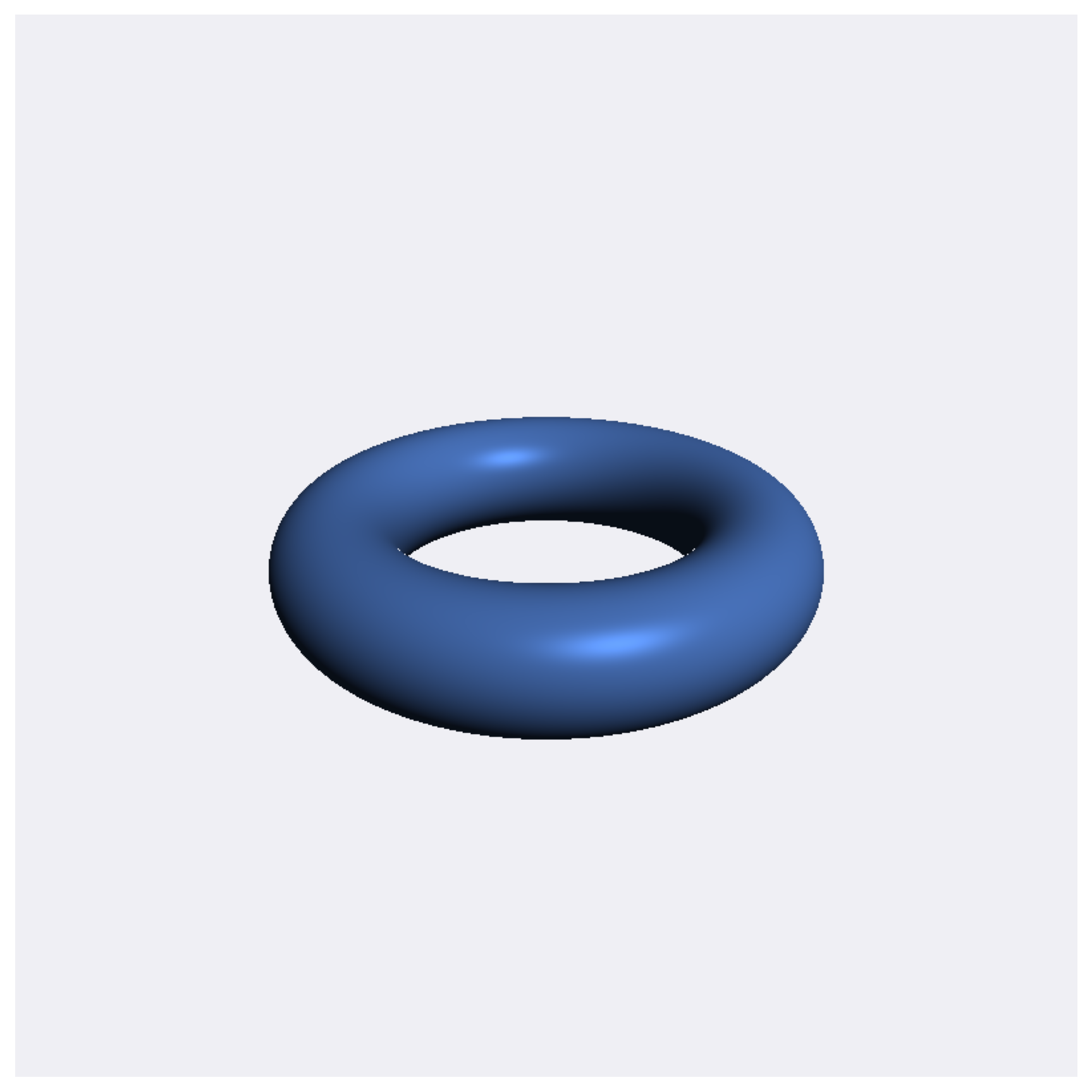
Figure 4: A rope entering the left portal and emerging from the right — the tori teleport whatever passes through their holes.